

With the technical revolution for 2026 season starting in March in Australia, the FIA has continued its relentless pursuit of safety by intervening in two areas: frontal impacts and rollover protection structures. In the first case, a two-stage nose crash test has been introduced to simulate a sequence of two successive impacts. In the second, significantly stricter load values have been imposed for the rollover hub.
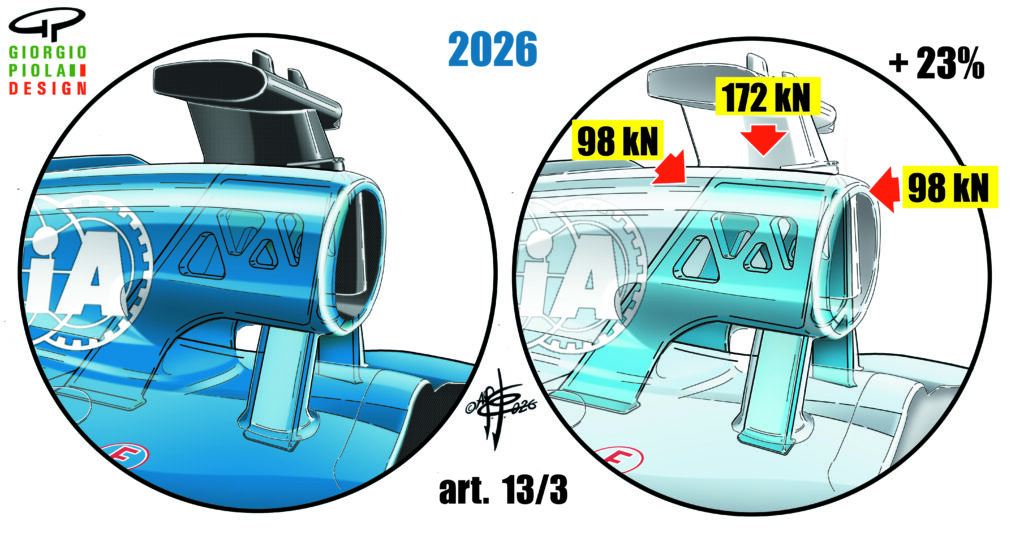
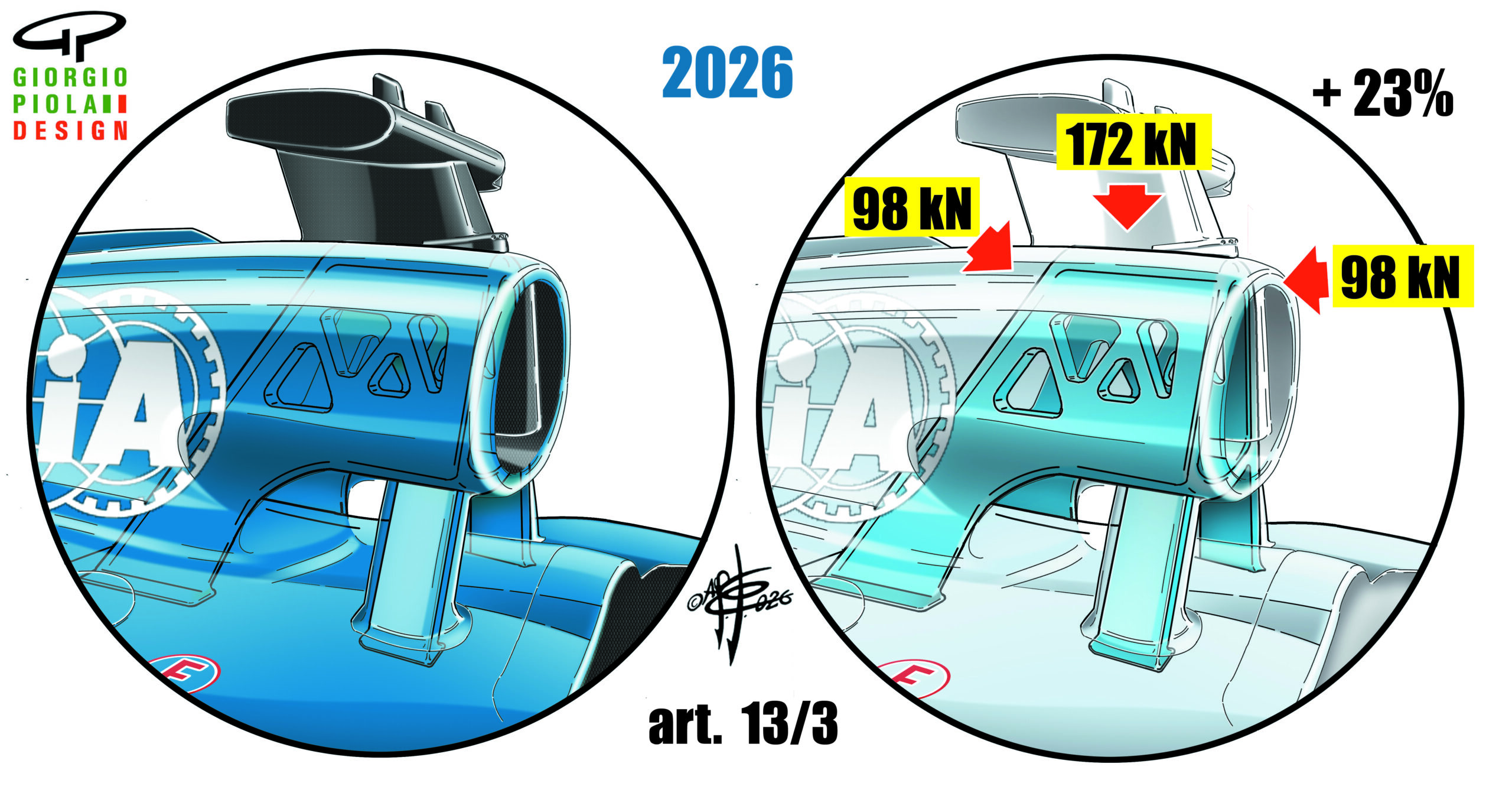
While waiting to see the first real single-seaters—amid the appearance of photos and renders of liveries worthy of a beauty contest—we can quickly review the progress made in safety structures for drivers’ heads. The structure itself, and above all the load values applied to the roll bar, have increased from 140 kN last season to 172 kN for the 2026 single-seaters, with an even more striking comparison when set against the tests from the year 2000.
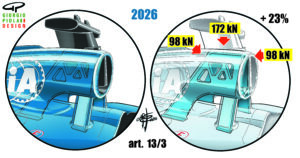
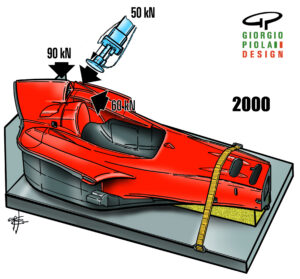
The vertical load value has almost doubled from 2000
Let’s see what Article 13.3 of the FIA 2026 Technical Regulations states on the matter:
“The principal roll structure must be subjected to one of the following static tests at 75% of the load (129 kN), followed by one of the tests at full load (172 kN). Both tests must be carried out on the same structure. Under the load, deformation must be less than 25 mm when measured along the loading axis, and any structural failure must be limited to 100 mm below the top of the roll structure when measured vertically.”
As early as the 2024 season, the FIA had already increased the values of the two-stage crash test. The first two tests involved the application of 8 tonnes in each direction, with opposite load directions between the two tests. The third test involved the application of a purely vertical load of 14 tonnes, compared to 10.5 tonnes in 2023
But when was the safety roll bar introduced? The first appeared in 1968, though their actual effectiveness in protecting drivers’ heads leaves many doubts. In the 1970s there were no crash tests, but the only element of a Formula 1 car that required certification signed by an engineer was the roll bar. I became aware of this through an “adventure” on the other side of the fence, when Arturo Merzario asked me to design some components of his first single-seater. I was, of course, very hesitant, because my résumé as a draughtsman included no formal technical drawing courses—only passion and experience, largely gained by following the development of one of the milestones of F1: Mauro Forghieri’s revolutionary Ferrari B3, driven by Merzario. The roll bar drawing was my second work done for the A1, obviously with the support of a “real” designer, engineer Gianni Marelli, who provided the certification required by the regulations.
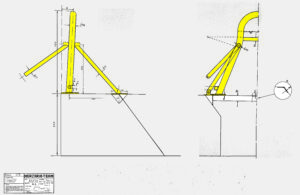
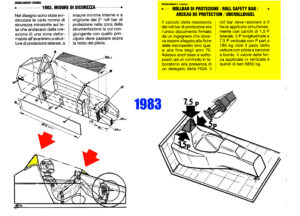
The first crash tests began in 1983, along with the introduction of a second roll bar at dashboard height. The driver’s head had to remain below the line connecting the two structures. The vertical force applied was 7.5 times the weight of the car, equal to 5,850 kg at the time.
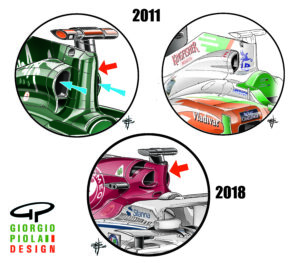
On many occasions, FIA interventions—even in the safety sector—have been aimed at curbing extreme solutions introduced by teams, such as the “knife-shaped” roll bar by Mercedes in 2010. This design obviously stemmed from aerodynamic requirements but raised concerns from a safety perspective.
The FIA promptly reacted in the following 2011 season, imposing minimum dimensions for this structure: a minimum cross-sectional area of 10,000 mm². Nevertheless, two teams still exploited this solution while complying with the new limits: Force India and Lotus, later used by Sauber (2018/19/22). The triangular structure was then mandated, still in use today and even strengthened for the 2026 single-seaters. Influencing this decision was the dramatic accident of Zhou at Silverstone, who emerged unscathed despite his car being completely overturned in an extreme crash.
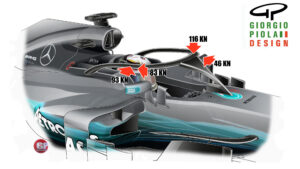
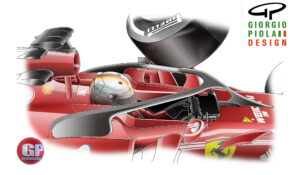
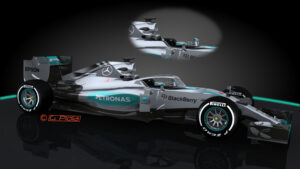
The most significant move in terms of driver safety was the introduction of the Halo, which was long resisted. After nearly two years of on-track testing, it was introduced in the 2018 season. The first driver to test it was Räikkönen with Ferrari in 2016. However, the Halo project originated from research commissioned to Mercedes in 2015. On that occasion, thanks to information passed to me by Michael Schmidt (an excellent source of technical scoops developed in collaboration, and my editor at Auto Motor und Sport), I was able to produce a preview remarkably close to its final version.
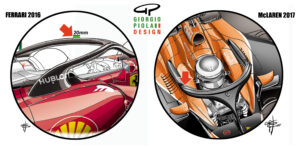
The official introduction came in 2018, with very strict crash tests and an additional test simulating an impact from a wheel thrown at 225 km/h. It is a titanium structure that surrounds the cockpit, designed to withstand extremely high loads and deflect objects. In recent years, it has played a major role in preserving drivers’ safety, becoming an essential safety feature.